

How the chain works
Each entry stores:UPDATE and DELETE on the table
outright, so tampering requires defeating both the trigger and the mathematics.
Verification
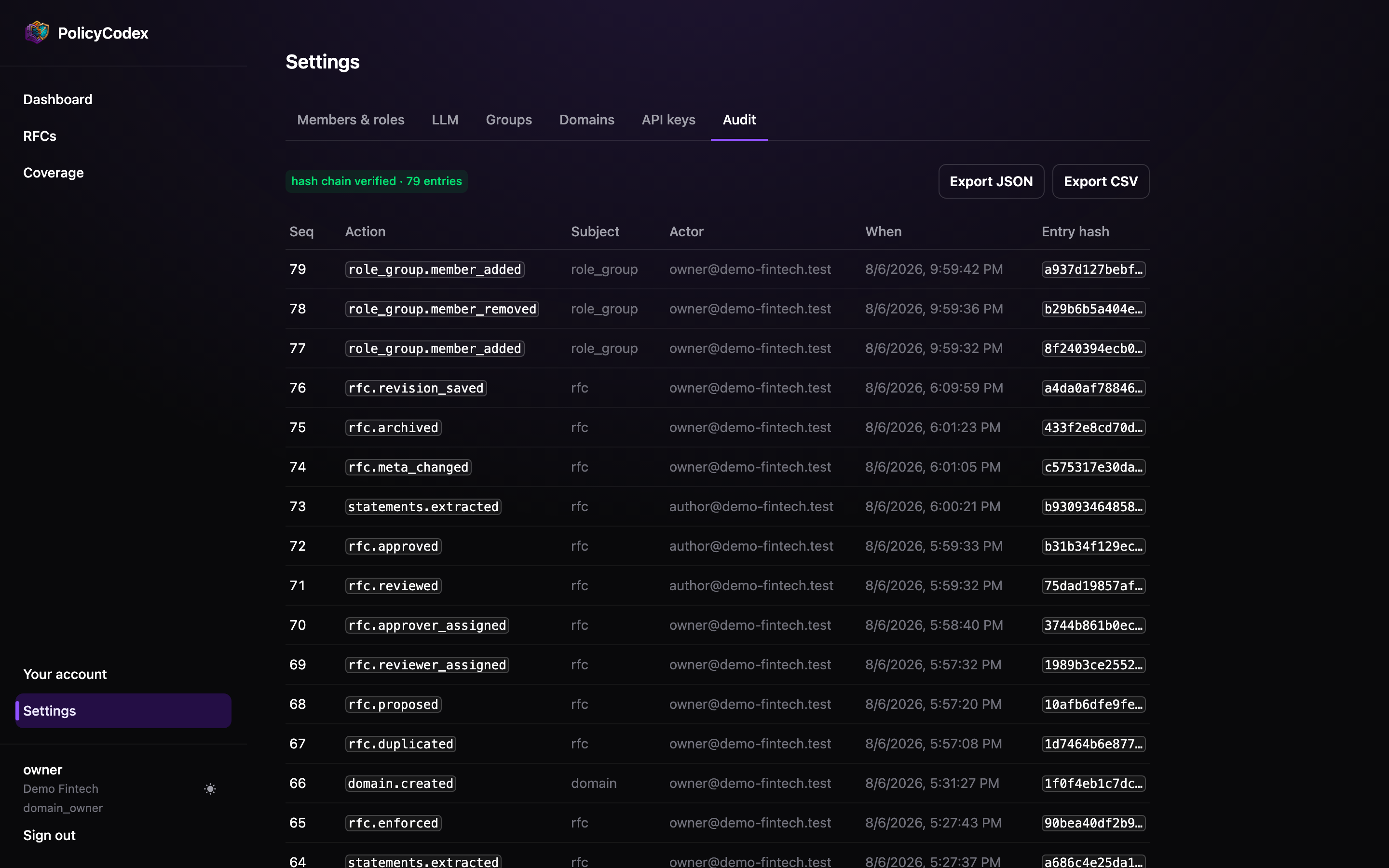
The green hash chain verified badge is not a claim from the server. The browser downloads every entry and recomputes the whole chain locally with the same function the command-line verifier uses. If verification fails, the badge turns red and names the sequence number where the chain broke. You can run the same check independently against the API — see the REST API.Reading the log
Newest entries appear first.
Actions you will see
RFC lifecycle
RFC lifecycle
rfc.proposed, rfc.reviewed, rfc.approved, rfc.enforced, rfc.deprecated,
rfc.revision_saved, rfc.duplicated, rfc.archived, rfc.meta_changedAssignment
Assignment
rfc.reviewer_assigned, rfc.approver_assignedStatements
Statements
statements.extracted — written whenever extraction runs, whether triggered by
approval or manuallyOrganisation
Organisation
domain.created, role_group.member_added, role_group.member_removed,
and API key lifecycle eventsExporting
Export JSON and Export CSV download the complete log.JSON
Includes every field, including full hashes. Use this when the export needs to be
re-verified — the recomputation needs the complete canonical entries.
CSV
Flattened for spreadsheets and GRC tooling. Convenient for review; not sufficient for
independent hash verification.
GET /v1/audit/export, which is how you
would wire PolicyCodex into a scheduled evidence collection job.
What the trail proves
For a given piece of code, you can reconstruct:1
Which statement was cited
The violation record names a statement slug.
2
Which RFC revision it came from
The statement records the revision it was extracted from — and revisions are immutable,
so that text is exactly what was approved.
3
Who approved that revision
The
rfc.approved entry names the approver and the moment.4
When it started blocking
The
rfc.enforced entry names who promoted it and when — so you can tell whether a
given merge predated enforcement.5
That none of it was edited afterwards
The hash chain verifies.