

Every check_compliance call — from the Action, the App, a full scan, or an MCP client — records the model used and its token usage. LLM cost turns that into a running estimate of what enforcement is actually costing.
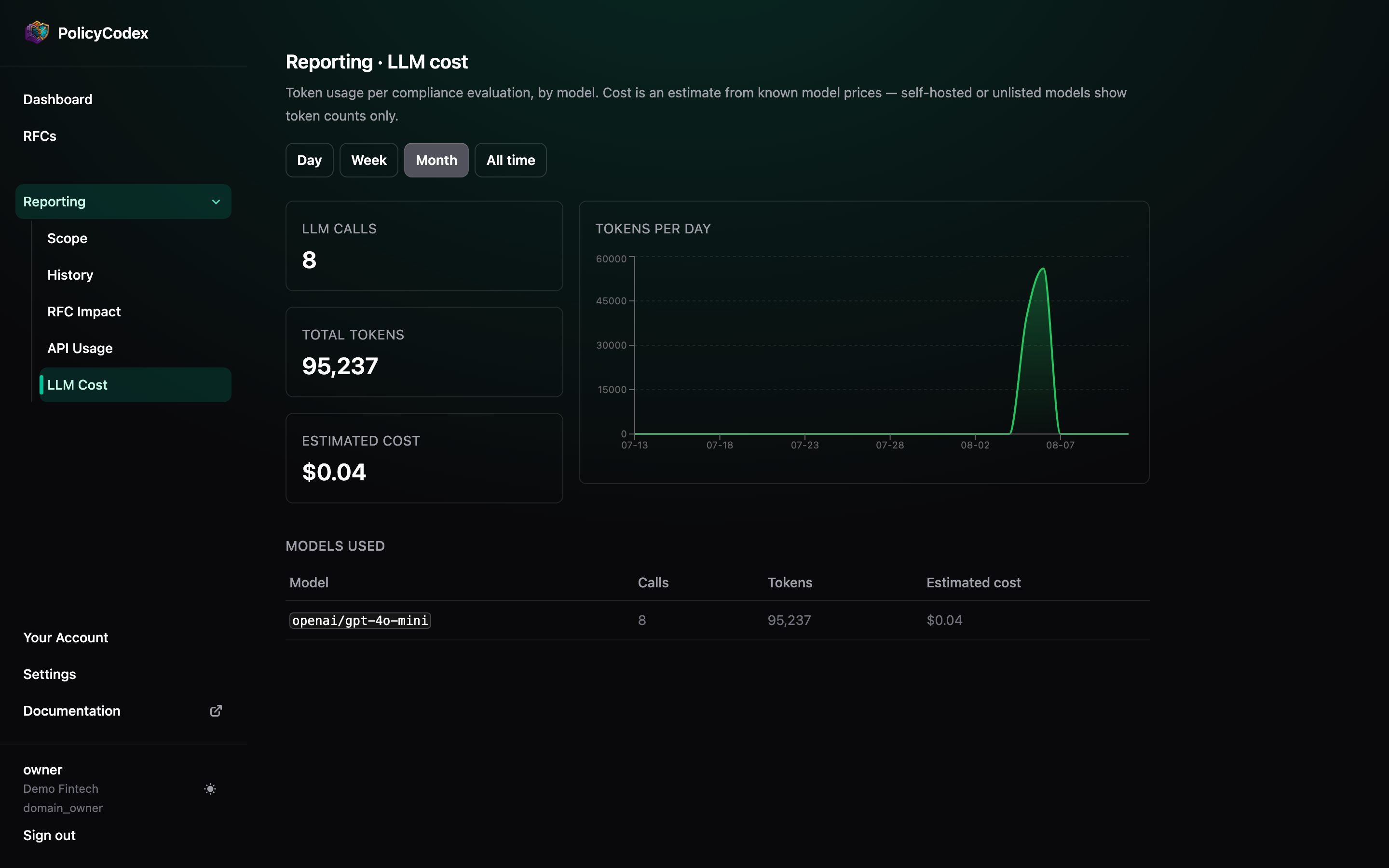
Reporting → LLM cost with call/token/cost tiles, a tokens-per-day chart, and a models-used table

Tiles

  • LLM calls — how many evaluations ran in the selected period.
  • Total tokens — prompt + completion tokens summed across those calls.
  • Estimated cost — priced from a static table of common model rates. Shows when nothing in the window matches a priced model.

Models used

Most orgs see more than one model here — a self-hosted or reconfigured LLM endpoint changes what future calls use without touching historical rows, and different check sources can be pointed at different models. Each row is one model: calls, tokens, and estimated cost, so a cost spike is traceable to a specific model rather than an undifferentiated total.

Why “estimated”

Cost here is a display estimate, not a bill. PolicyCodex’s LLM config can point at any OpenAI-compatible endpoint — including a self-hosted one — so there’s no universal source of truth for what a token actually costs your org. The estimate covers a fixed table of common commercial model prices; anything outside that table shows a token count with no dollar figure rather than a guess.

Tokens per day

An area chart of daily token volume across the selected window, sharing the same green accent as the rest of Reporting. Spikes usually track full scans — a whole-repository evaluation costs far more tokens than a single PR diff.