

Organisation
Your tenant. Every RFC, domain, statement, API key and audit row belongs to exactly one organisation, and row-level security in the database enforces that boundary — there is no query that can reach another organisation’s data. You join an organisation by being invited to it. Creating one makes you its firstdomain_owner.
Architecture domain
A subject area that standards are grouped under, owned by one person.api-design,
secure-coding and incident-response are typical.
Domains matter more than they look:
- They decide who can approve — the domain owner is always an eligible approver.
- They are the filter agents and CI use. A pipeline can check one domain rather than the whole corpus.
- They section the compiled output —
AGENTS.mdis organised by domain.
RFC
One standards document, in Markdown with YAML frontmatter: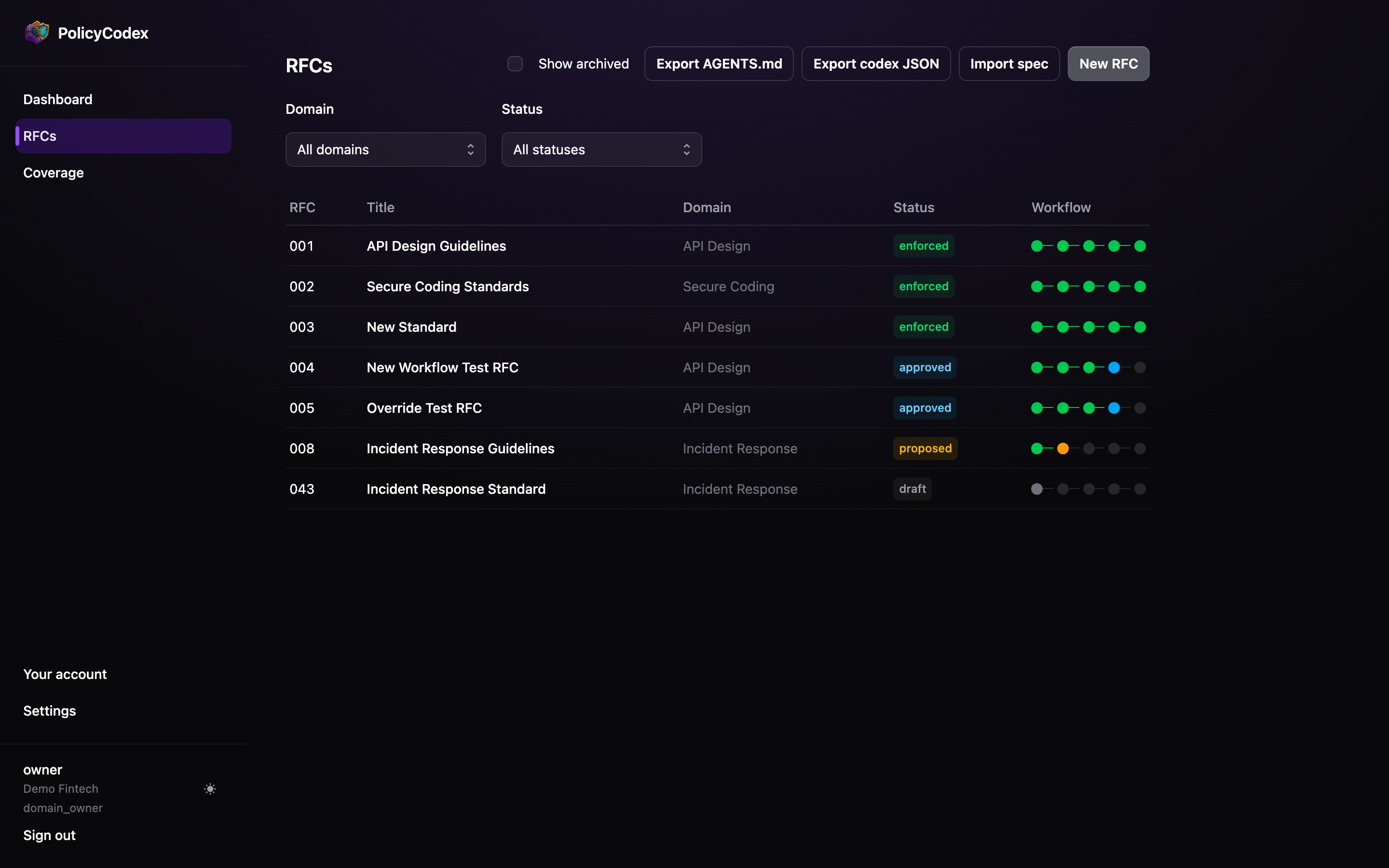
Revisions are immutable. Saving a revision writes a new row rather than editing the
old one, so the exact text that was approved can always be recovered — which is what
makes the audit trail meaningful.
Statement
A single testable requirement extracted from an RFC. This is the unit agents and CI actually consume.
Slug stability is the load-bearing property. A violation recorded six months ago still
resolves to the same statement today, even after the RFC has been rewritten around it.
When a statement genuinely disappears it is marked
retired, never deleted.
Level and severity
RFC 2119 levels map directly onto CI behaviour:MUST / MUST NOT
Blocking. A finding against an enforced MUST fails the check.
SHOULD / SHOULD NOT
Warning. Reported on the pull request, does not fail the check.
MAY records a permitted option and never produces a finding.
Lifecycle status
approved and enforced:
approved— statements are extracted and served to agents, and CI findings are advisory. This is your grace period.enforced— MUST-level findings block merges.
Member role
Your role in the organisation, set per member:
Roles are assigned in Settings → Members & roles; the
per-RFC reviewer and approver assignments use groups.